
4 inch Hydraulic Trash Pump
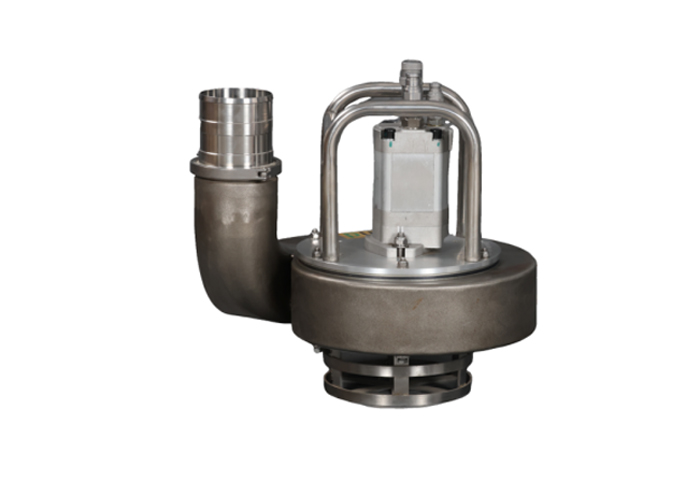
Specifications of 4 inch hydraulic trash pump
The 4 inch Hydraulic trash pump can process fluids with tough environment.Pump high volumes of water, sand slurries, gravel, sludge and so on. Use for highway, municipal affairs, gas, heavy rescue & recovery and natural disasters
◎Features
◆Small size, light weight, and easy to carry
◆Strong pumping capacity, allowing the pumping of solid content up to 25%
◆ Strong pumping capacity
| Type | T3-120 | T4Pro-220 | T6-240 |
|---|---|---|---|
| Weight (kg) | 16 | 25 | 29 |
| Output (m³/h) | 120 | 220 | 240 |
| Max. Head | 30 | 25 | 20 |
| Output flow(lpm) | 26-34 | 30-38 | 30-38 |
| Operating pressure(bar) | 105-140 | 105-160 | 105-160 |
| Dimension(mm) | 410×300×435 | 470×410×450 | 470×410×455 |
| Outlet (mm) | Φ75 | Φ100 | Φ150 |
Core Definition and Structure
Drive: Hydraulic motor (not electric motor), supplied by an external hydraulic power Pack.
Type: Mostly submersible, but self-priming is also available; primarily centrifugal, with large-channel/clog-free impellers.
Core Capabilities: Hydraulic Trash Pump Can handle solid particles of 20–76 mm (0.8–3 inches), conveying mud, sewage, gravel, and sludge.
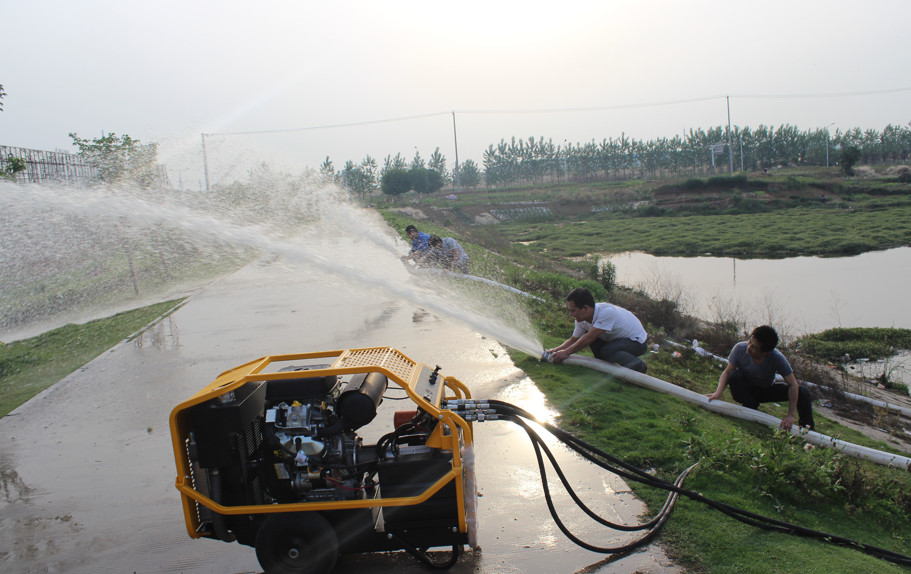
Introduction to Hydraulic Trash Pumps: The Heavy-Duty Fluid Movers
When standard water pumps fail due to thick sludge, rocky debris, or extreme environments, the hydraulic trash pump steps in. Unlike common gas-powered or electric pumps, these units are engineered to “swallow” solids and operate in conditions that would destroy conventional machinery.
By separating the power source from the pump head, hydraulic systems offer a unique combination of safety, portability, and raw torque.
1. The Core Concept: Power vs. Suction
Most portable pumps are “suction-side” units, meaning they sit above the water and pull it up through a hose. This limits them to a physics-based lift of about 25 feet.
A hydraulic trash pump is a “pusher.” The pump head is submerged directly into the liquid, and power is delivered via high-pressure hydraulic oil from a remote Hydraulic Power Pack or an excavator. Because it pushes the fluid from the bottom, it can achieve significantly higher discharge heads and move much thicker material.
2. Anatomy of a "Trash" Eater
What qualifies a pump as a “trash” pump is its ability to handle spherical solids. While a standard centrifugal pump might clog on a pebble, a hydraulic trash pump is built with:
The Semi-Open Impeller: Designed with large clearances to allow rocks, twigs, and debris to pass through without jamming.
The Volute Casing: A heavy-duty “spiral” chamber that directs the debris-laden slurry toward the discharge outlet.
The Hydraulic Motor: A compact, oil-driven motor that provides massive breakaway torque to spin the impeller even when buried in thick mud.
3. Key Advantages of Hydraulic Drive
Using pressurized oil instead of electricity or a direct engine drive offers several technical benefits:
Submersibility: There are no electrical components, so the pump can be fully inundated in water, sewage, or mud without risk.
Spark-Proof Safety: Because the power source (the engine) can be placed 50 to 100 feet away from the pit, these pumps are “intrinsically safe” for use in refineries or manholes where explosive gases might be present.
Variable Speed: You can adjust the pumping speed simply by turning a flow control valve on the power pack—no complex electronics required.
Self-Lubricating: The internal motor is constantly bathed in hydraulic oil, which prevents the corrosion and “seizing” common in electric submersibles.
4. Common Industrial Applications
You will typically find these hydraulic trash pumps in “worst-case” scenarios:
Municipal Bypass: Moving raw sewage during pipe repairs.
Construction Dewatering: Clearing flooded foundation pits filled with gravel and silt.
Dredging: Removing sediment from the bottom of ponds or canals.
Emergency Response: Pumping out basements or subways after a flood where debris is rampant.
Technical Comparison at a Glance
| Feature | Gas-Driven Centrifugal | Electric Submersible | Hydraulic Trash Pump |
| Solids Handling | Limited (Low) | Moderate | Excellent (High) |
| Portability | High (but bulky) | High (requires grid/gen) | Moderate (requires hoses) |
| Safety | Exhaust fumes/Spark risk | Electrocution risk | Highest (Submersible/Spark-proof) |
| Maintenance | High (Engine tuning) | Moderate (Seal checks) | Low (Self-lubricating) |