
Table of Contents
ToggleIntroduction to Demolition Tools
Overview of Handheld Hydraulic Jack Hammers
Handheld hydraulic jack hammers are compact yet extraordinarily potent demolition tools. Powered by hydraulic pressure, they channel immense impact energy through a chisel or moil point. Unlike their pneumatic counterparts, these hammers operate with precision, delivering consistent performance even in the most demanding conditions.
Overview of Air Breakers
Air breakers, commonly known as pneumatic jack hammers, are powered by compressed air. They have long been a staple on construction sites, renowned for their raw power and reliability. However, they often require bulky air compressors and can be less efficient in certain environments.
Why Comparing Them Matters
Choosing the right demolition tool is not trivial. Performance, safety, cost, and suitability for specific materials vary significantly between these two systems. A well-informed decision can save time, money, and operator fatigue.
Handheld Hydraulic Jack Hammer vs Air Breakers (Pneumatic Breakers)
Working Principle & Power System
Handheld Hydraulic Jack Hammer
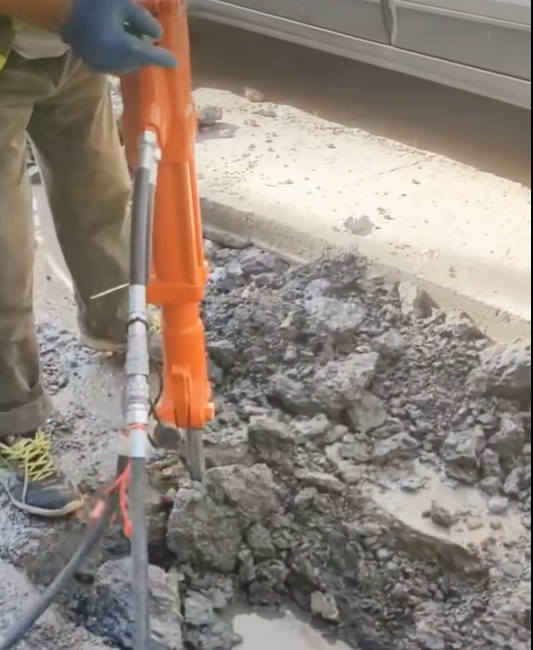
- Handheld Hydraulic jack hammer Powered by a hydraulic power pack (gasoline/diesel engine), delivering high hydraulic pressure (90–140 bar).
- Closed hydraulic circuit; no exhaust fumes or oil mist emission.
- Matched with hydraulic hoses for continuous high-power impact drive.
Air Breaker / Pneumatic Jack Hammer
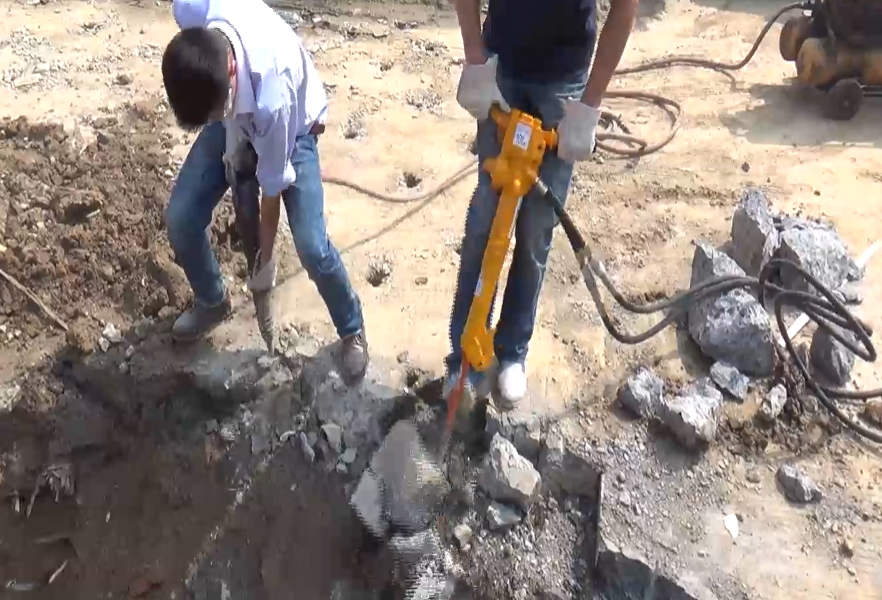
- Driven by an air compressor with compressed air (6–8 bar).
- Open air loop; exhausts air mixed with oil fog during operation.
- Requires air hoses, water-oil separators for normal work.
Core Performance Comparison
| Comparison Item | Handheld Hydraulic Jack Hammer | Air Breaker |
|---|---|---|
| Impact Energy | High (40–120 J), high breaking efficiency | Low (20–60 J), 20%–40% lower efficiency |
| Blow Frequency | 1500–2000 BPM, stable output | 1800–2500 BPM, faster frequency but weaker force |
| Noise Level | 90–95 dB, low noise for urban construction | 110–120 dB, extreme high noise |
| Vibration | Excellent anti-vibration design, less operator fatigue | Severe hand-arm vibration, long-term health risks |
| Weight (Main Unit) | 15–25 kg, heavier single body | 8–15 kg, lightweight & easy to carry |
| Working Angle | Stable for horizontal, overhead & all-angle jobs | Poor performance in horizontal/upside-down operation |
| Environmental Adaptability | Fume-free; safe for confined spaces, underground & sensitive areas | Oil mist exhaust; not allowed in enclosed/explosion-proof sites |
| Energy Consumption | Fuel-saving, 30%–50% lower operating cost | High power loss from compressors & air pipelines |
Cost & Maintenance
Handheld Hydraulic Jack Hammer
- Higher initial purchase cost (handheld hydraulic jack hammer + Hydraulic power pack set).
- Closed oil circulation reduces component wear; long service life.
- Simple daily maintenance: replace hydraulic oil & filters only; low long-term running cost.
Air Breaker
- Low entry cost for the breaker itself; affordable basic configuration.
- Air pipelines easily intake dust; internal valves & pistons wear fast.
- Frequent repairs & high electricity/fuel cost for compressors; expensive for long-duration projects.
Application Scenarios
Choose Handheld Hydraulic Jack Hammer for:
- Urban/residential area construction, night work & environmental restriction sites.
- Heavy-duty continuous demolition, road repairing, mining jobs.
- Underground tunnels, enclosed spaces & explosion-proof required works.
- Horizontal/overhead breaking tasks; long-cycle engineering projects.
Choose Air Breaker for:
- Short-term small jobs, renovation work & emergency sporadic breaking.
- Remote sites without stable power supply; fast on-site deployment.
- Low budget demand & simple vertical light breaking only.
- Jobs requiring lightweight handheld flexibility for short shifts.
Choosing the Right Tool for the Job
Assessing Job Requirements
Consider material hardness, scale of demolition, and precision needs. Heavy-duty, continuous, or precision work favors hydraulic breakers, while intermittent tasks may suit air breakers.
Environmental and Safety Considerations
Wet, explosive, or confined workspaces often necessitate hydraulic solutions. Open, well-ventilated areas can accommodate pneumatic systems safely.
Balancing Cost, Performance, and Convenience
The decision ultimately rests on weighing upfront cost, operational efficiency, operator comfort, and logistical considerations. Both tools have merits, but matching them to specific needs ensures optimal results.
Summary Recommendation
- Prioritize handheld hydraulic jack hammer: high efficiency, low noise, eco-friendly, long service life, cost-effective for heavy & long-term tasks.
- Prioritize air breaker: low upfront cost, easy operation, ideal for light, temporary & budget-limited breaking work.