
Light Weight HandHeld Hydraulic breaker
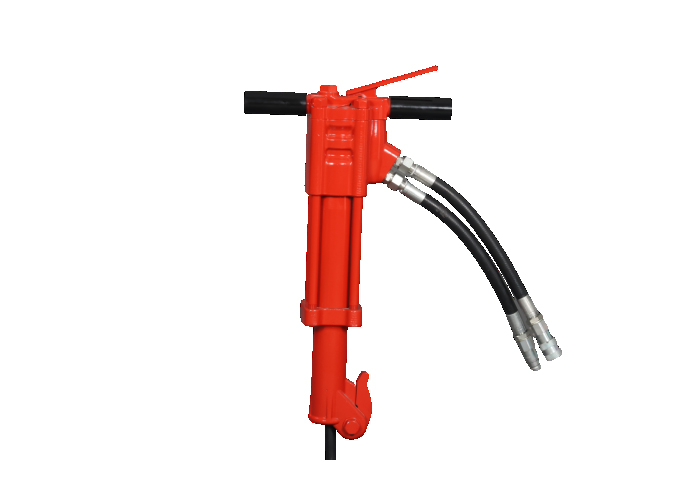
Light weight Handheld Hydraulic breaker
Product Details:
- Product Type: Handheld Hydraulic breaker
- Model: HB20S
Specifications for handheld hydraulic breaker
NewaLux handheld hydraulic breaker are designed with patents.No matter what is the bad situation in the fields, demolition job can be performed effectively and safely.
◎Features
◆Small size and light weight
◆Powerful impacting energy and low reverse impacting
◆Low noise, high reliability, and durable working
◆Breaking bits of hand held hydraulic breaker for different demands
| Type | HB18 | HB18S | HB20 | HB20S | HB28 | HB28S |
|---|---|---|---|---|---|---|
| Weight(kg) | 18 | 19 | 20 | 21 | 28 | 29 |
| Output flow(lpm) | 15-24 | 15-24 | 26-34 | 26-34 | 26-34 | 26-34 |
| Operating pressure (bar) | 90-140 | 90-140 | 105-140 | 105-140 | 105-140 | 105-140 |
| Impact frequency (bpm) | 1800-2400 | 1800-2400 | 1800-2400 | 1800-2400 | 1800-2400 | 1800-2400 |
| Bits size (in.Hex) | 1×4-1/4 | 1×4-1/4 | 1×4-1/4 | 1×4-1/4 | 1-1/8×6 or 1-1/4×6 | 1-1/8×6 or 1-1/4×6 |
| Model of handle | T-handle | Anti-vibration handle | T-handle | Anti-vibration handle | T-handle | Anti-vibration handle |
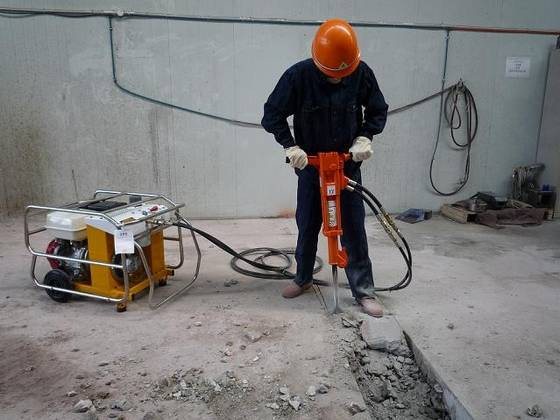
Applications of Handheld hydraulic breaker
1. Urban Utility and Street Maintenance
In dense urban environments, space and noise are major constraints. Handheld hydraulic breakers are the preferred tool for “opening the ground” to access buried infrastructure.
Asphalt Cutting: Using a wide-chisel bit to cleanly cut through road surfaces for pipe repairs.
Utility Potholing: Breaking through concrete sidewalks or reinforced road bases to reach water, gas, or fiber-optic lines.
Patchwork: Removing damaged sections of pavement for localized “patch and repair” jobs.
2. Indoor Renovation and Selective Demolition
Because hydraulic power packs can be kept outdoors while the breaker is used inside, these tools are ideal for indoor projects where exhaust fumes from gas-powered tools would be hazardous.
Floor Removal: Stripping away thick concrete slabs or tiled surfaces in warehouses and commercial buildings.
Wall Breaching: Creating openings for new doors or windows in reinforced masonry walls.
Stairwell Demolition: Their compact size allows operators to work in tight stairwells or basements where large machinery cannot fit.
3. Specialized Underwater Construction
One of the most unique applications of handheld hydraulic breakers is their ability to operate submersibly. Unlike pneumatic tools, which struggle with backpressure and air bubbles, or electric tools, which pose a lethal shock risk, hydraulic systems are closed and waterproof.
Marine Salvage: Breaking up underwater obstructions or concrete pilings.
Pier and Dock Repair: Clearing away degraded concrete from submerged structures to allow for fresh reinforcement.
4. Mining and Trenching
In landscaping and small-scale mining, these tools provide the “punch” needed to handle materials that are too hard for a manual pickaxe but too small to justify a large excavator-mounted hammer.
Rock Breaking: Splitting large boulders or outcroppings encountered during trenching for retaining walls or swimming pools.
Frozen Ground: In cold climates, they are used to break through “permafrost” or frozen topsoil during winter construction.
5. Post Driving and Compaction
With the right attachments, a handheld hydraulic breaker can be converted from a demolition tool into a construction tool.
Fencing and Signage: Using a “post-driver” head to force metal T-posts or wooden fence stakes into hard-packed soil.
Backfill Compaction: Using a “tamping plate” to compact soil in narrow trenches where a vibratory plate compactor cannot maneuver.
6. Emergency and Rescue Operations
Fire and rescue teams often use handheld hydraulic breakers during “heavy technical rescue” scenarios.
Search and Rescue: Breaking through collapsed concrete floors or walls to reach victims trapped in earthquake or building-collapse zones.
Forced Entry: Quickly removing reinforced barriers during high-stakes emergency situations.
Here is a quick guide to help you dial in your setup.
1. Selecting the Right Tool Bit (The Business End)
The shape of the bit determines how the kinetic energy is dispersed into the material. Using the wrong bit is like trying to cut a steak with a spoon—it’s frustrating and inefficient.
| Bit Type | Visual Shape | Best Used For… | Why? |
| Moil Point | Conical/Pyramid | Reinforced concrete, hard rock, and general demolition. | It focuses all the energy into a single point to “crack” the material’s structure. |
| Chisel Bit | Flat edge (Narrow) | Trenching, cutting through asphalt, or prying apart layered masonry. | The “blade” action provides directional control, perfect for creating clean lines. |
| Asphalt Cutter | Wide, thin blade | Fresh asphalt or frozen ground. | The wide surface area prevents the tool from sinking too deep while slicing the surface. |
| Tamping Plate | Flat, square head | Soil and backfill compaction in narrow trenches. | It turns the “hit” into a vibratory force to pack down loose earth. |
2. Understanding Hydraulic Flow (GPM & PSI)
Every handheld hydraulic breaker has a specific Flow Range and Operating Pressure. If your power source (like a mini-excavator or a power pack) doesn’t match these numbers, you’ll run into trouble.