
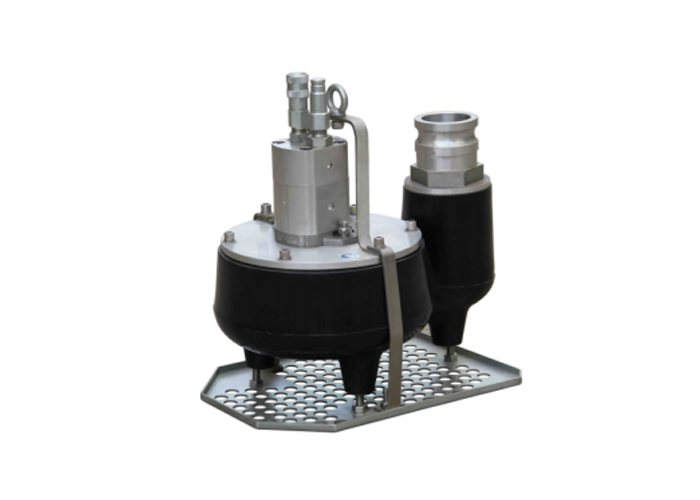
I. Advantages of Hydraulic Submersible Pumps
- High Intrinsic Safety & Explosion-Proof Nature
- Core Advantage: This is the most significant benefit. Since the submersible unit contains no electric motor, there is absolutely no risk of electrical sparks. This makes it the preferred choice for pumping flammable liquids like oil, fuel, chemicals, or other hazardous fluids in environments such as oil rigs, chemical plants, mines, and ship bilges.
- No Risk of Electric Shock: In wet or submerged environments, electric pumps pose an electrocution hazard, which is completely eliminated with hydraulic pumps.
- High Power Density and High Head Capability
- Powerful: Hydraulic power pack can deliver very high power, capable of driving high-flow pumps and achieving very high heads (up to several hundred meters or more).
- Excellent Overload Protection: The hydraulic system features a relief valve. If the pump becomes blocked or overloaded, the system pressure reaches a set limit, and the valve opens, protecting the pump and motor from damage. The system can safely stall without burning out.
- Infinitely Variable Speed Control
- By adjusting the flow from the surface power unit (using a proportional valve or variable displacement pump), the speed of the submersible pump can be smoothly and infinitely varied . This allows for precise control over flow rate and head pressure. The soft-start and soft-stop characteristics are also gentler on the system and piping.
- Compact Design and Flexible Installation
- The submersible unit (hydraulic motor + pump) is typically compact, making it suitable for installation in confined spaces like ship holds or deep wells.
- The hydraulic power pack can be placed in a safe, dry, and well-ventilated location away from the pumping point, connected only by hydraulic hoses, offering great layout flexibility.
- High Reliability and Long Service Life
- Hydraulic motors are robust, resistant to shock and vibration, and suitable for continuous operation in harsh conditions.
- Inherent overload protection enhances reliability and prevents damage from unexpected situations.
II. Disadvantages of Hydraulic Submersible Pumps
- Lower Overall System Efficiency
- Core Disadvantage: Energy undergoes multiple conversions: Prime Mover (diesel engine or electric motor) → Hydraulic Pump → Hydraulic Lines → Hydraulic Motor → Water Pump. Each conversion involves energy losses, resulting in a lower overall system efficiency compared to an electric submersible pump of similar power.
- High Initial Investment Cost
- The system requires not only the submersible unit but also an expensive surface-mounted hydraulic power pack (reservoir, pump, valves, cooler, filters, etc.), leading to a higher total initial cost.
- High Maintenance Requirements
- Hydraulic systems are extremely sensitive to fluid cleanliness, requiring regular oil and filter changes. Failure to do so can damage precision components.
- Risk of hydraulic fluid leaks from surface lines or submersible seals, which can pollute the environment and be difficult to repair.
- Requires specialized technicians for maintenance and troubleshooting.
- Sensitivity to Ambient Temperature
- In cold environments, hydraulic fluid viscosity increases, making starting difficult and potentially requiring pre-heating. In high temperatures, fluid can overheat, degrading its quality and affecting performance, often necessitating a cooling system.
- Noise
- The surface hydraulic power pack (especially when diesel-engine driven) can generate significant noise during operation.
Summary and Application Scenarios
Summary Table:
FEATURE | HYDRAULIC SUBMERSIBLE PUMP | ELECTRIC SUBMERSIBLE PUMP |
|---|---|---|
Safety | Excellent (Intrinsically Safe/Explosion-Proof) | Requires special design to be explosion-proof |
Efficiency | Lower | Higher |
Initial Cost | Higher | Lower |
Control | Excellent (Variable Speed) | Requires VFD, adds cost |
Maintenance | Specialized, demanding | Relatively simpler |
Ideal For | Hazardous, wet, high-power | General industrial, municipal, agricultural |
Primary Applications:
Hydraulic submersible pumps are specialized tools with irreplaceable advantages in specific fields:
- Oil, Gas & Chemical Industry: Transferring crude oil, fuels, chemicals, and other flammable or explosive media.
- Marine & Offshore: Bilge pumping, ballast water transfer, fire pumps.
- Mining: Mine dewatering, especially in areas with risk of gas explosion.
- Emergency & De-watering: High-flow dewatering in flood situations where electrical power is unavailable, often using diesel-driven hydraulic power packs.
- Specialized Industrial/Municipal: Applications requiring very high power, high head, or precise flow control.
Conclusion: The choice between a hydraulic and an electric submersible pump primarily depends on the safety requirements of the application . In safety-critical, hazardous environments, the hydraulic submersible pump is the undisputed best choice, where its advantages far outweigh the disadvantages of efficiency and cost. For general water supply, drainage, and agricultural irrigation, the more efficient and economical electric submersible pump is more common.