
Table of Contents
ToggleWhat a concrete pump hose is made of
A concrete pump hose is a reinforced rubber composite built to resist abrasion inside the tube and to contain high pulsing pressures in the carcass. Most placement hoses use steel wire helixes or spiral reinforcements; textile or fabric reinforcements appear in lighter-duty or lay-flat variants. Reinforcement count and construction drive three things you care about when buying:
- Working pressure—and the margin between working and burst pressure
- Minimum bend radius—how tight you can safely route the hose
- Weight per foot or meter—which affects handling and boom tip loads
Sizes and pressure ratings explained
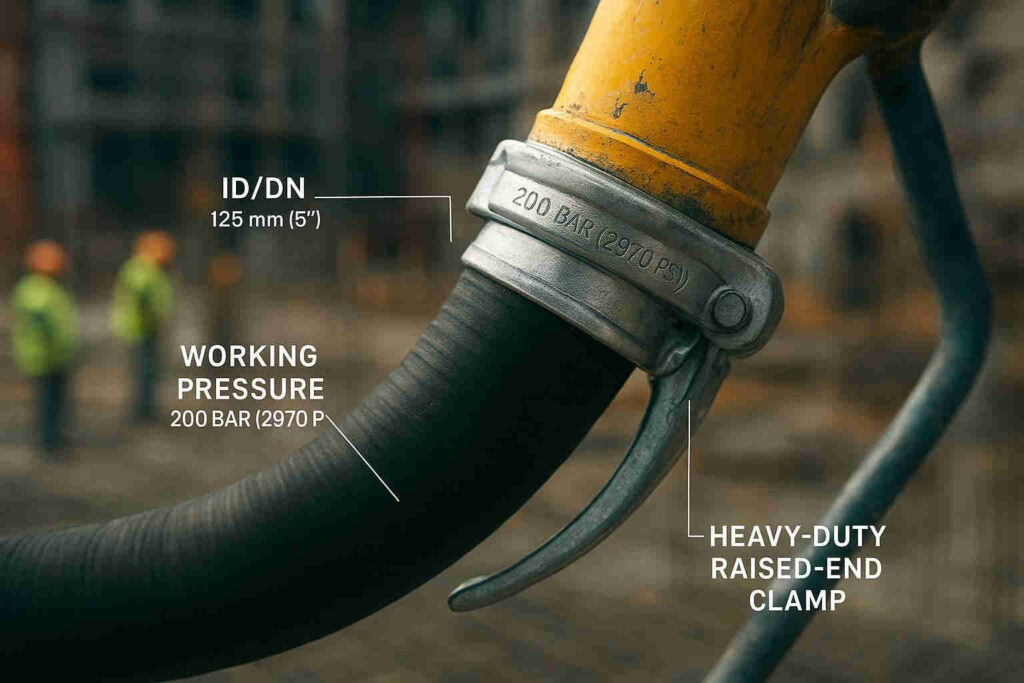
Concrete hose sizes are shown in both inside diameter (inches) and DN (millimeters). DN125 means roughly 125 mm ID, commonly referred to as 5 in. Hose working pressure is the sustained rating; burst pressure is the tested failure threshold. Many construction-duty hoses publish a 2:1 ratio between burst and working pressure; some high-performance series publish higher ratios—always check the specific table.
Quick conversion helper
| Measure | Value |
|---|---|
| 1 bar | 14.5 psi |
| 85 bar | ≈ 1,233 psi |
| 100 bar | ≈ 1,450 psi |
| DN100 | ≈ 4 in |
| DN125 | ≈ 5 in |

Common selection mistakes
- Using grooved‑end couplings in a concrete pumping line. Even if a grooved clamp “fits,” its rated working pressure is typically far below modern pump system pressures. This is a standards and physics mismatch that invites separations.
- Mismatching hose or clamp working pressure to the pump. If your pump can develop 100–150 bar, choose hoses and clamps rated to at least that working pressure across the entire system.
- Undersizing the hose relative to aggregate. A 1‑1/2 in aggregate in a 4 in hose is a blockage recipe. Follow the one‑third rule and scale up where slump, fibers, or angular particles demand more clearance.
- Overloading the boom tip with length or reducers. Extra reducers, elbows, or a second end hose can quickly exceed tip weight limits and degrade handling.
- Mixing clamp systems or brands without verifying geometry and torque requirements. Small geometry mismatches show up as leaks or sudden joint separations under pulsation.
Each mistake above is preventable with a short pre‑purchase checklist and a glance at the right catalog tables.
Inspection notes that affect selection
Inspection is a selection issue as much as a maintenance issue. If you see any of the following when sourcing or receiving hoses, reject or reroute them to low‑risk uses:
- Cuts, bulges, or exposed reinforcement at bends or the coupling end
- Bell‑mouthing, gouged sealing faces, or out‑of‑round end fittings
- Missing or unreadable labels for working pressure, size, or manufacturer
- Hardened, cracked, or incorrect sealing rings
Operator study guides and supplier maintenance pages reinforce these cues; they are the early signs of reduced pressure capacity and higher failure risk.